
Image of the Week: Making 5 and 10
October 12, 2025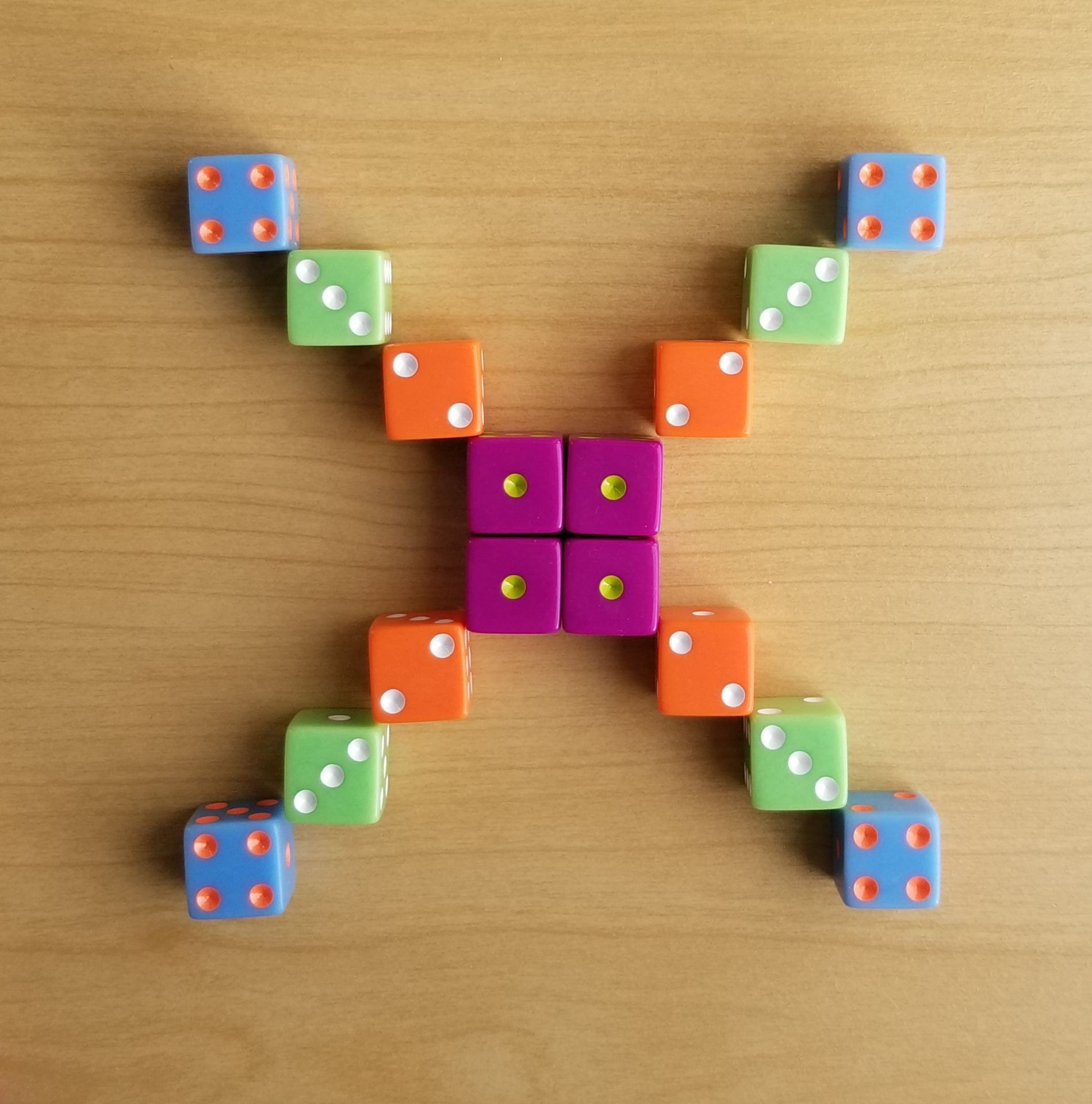
Making 5 and 10
One of the most powerful and flexible early joining strategies is to learn to make and use fives and tens. Ten anchors our number system because humans have 10 fingers, and with five on each hand, half of ten becomes a springboard into base ten thinking. Connecting five and ten to our fingers – the original manipulatives – is critical to understanding our number system and seeing (and feeling) how numbers can be composed and decomposed. As you give students experience with their fingers, help them begin to abstract the ideas of five and ten using other manipulatives, like the dice in our image of the week. Take a moment and look at this image. How many do you see? What different ways might your students see how many are in this image?
Students may simply count the dots, either by ones or with skip counting or some combination. In fact, this is the most direct entry into this task, even though it is more laborious. It takes more understanding – but less work – to use the structure of the dice to create fives and tens. This is a key insight – there are no fives or tens in this image but knowing that those units can help and seeing ways to create them in a big mathematical leap. Students might notice that they can put a 2 and a 3 together or a 4 and a 1 together to make a 5. Students can then skip count by five or notice that any two groups of five make 10. It may be most straightforward to see each arm of the pattern (and 4 + 1 and 3 + 2) as a ten, but some students may want to join similar fives (3 + 2 and 3 + 2) from different arms. Or they may make tens in unexpected ways, say by taking two 4s and a 2 from different parts of the image. However, they do it, making fives and tens makes finding the total number of dots much easier.
As an extension, ask students, How could you extend this pattern? How many dots would there be then? How do you know? If you have access to dice, students can construct and extend this pattern. If not, students can simply draw and extend the pattern. Some students will want to add dice to the center of the image, pushing the dice outward, while others will made add to the edges.
So many big ideas open up when we start by building 5 and 10! Try this or any of our other Making 5 and 10 activities with your students tomorrow.
To multiplicity, cheers!
Jen Munson and the multiplicity lab group